Automating Credit Approval: Customer Experience in Digital Banking
In today's financial industry, being "correct" is not enough; it must be "fast." Customers expect a seamless digital experience: instant registration, verification in a moment. However, the biggest barrier lies in the manual post-check process, with many layers of disparate reconciliations.
This is when Credit Scoring and Automated Approval become strategic "weapons" in the digital transformation roadmap.
1. Classic "bottlenecks" in the traditional process
Many organizations are falling into the trap: the growth of applications is proportional to the operational burden.
Slow processing speed:With products like BNPL or credit cards, just a few hours of delay can lead customers to competitors.
Emotional decision-making:The quality of assessments depends on personal experience, leading to inconsistency between branches.
Low productivity:The team of experts is bogged down with simple applications, leaving little time for complex cases.
2. What is credit scoring & automatic approval?
It's not just about "scoring"; this is aDecision Enginebased on data and AI to automate 4 scenarios:
Auto-Approve:Instant approval for low-risk groups.
Auto-Reject:Direct rejection for ineligible groups.
Refer to Manual:Transfer to specialists for "borderline" applications.
Tailored Offer:Automatically propose personalized limits and interest rates.
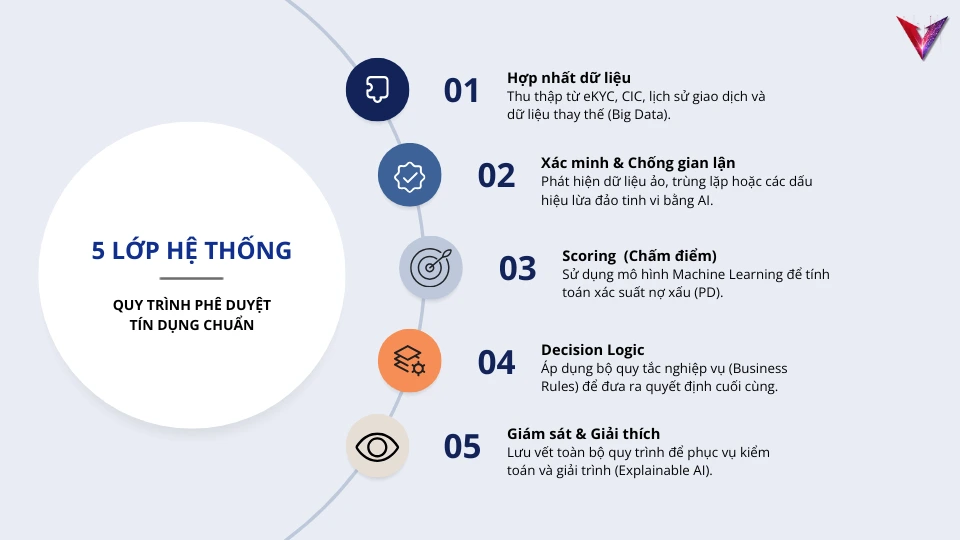
3. The 5-layer architecture of a standard operating system
To replace human intervention while ensuring safety, the system needs to operate through 5 strict layers:
Implementation Conditions
To implement effectively, businesses need to ensure at least four factors.
1. Data is clean enough for decision-making
A model is only as good as the reliable input data. Lack of data, fragmented data, or low verification quality will significantly reduce the value of the system.
2. There is consensus between business and technology
This is not a project solely for IT or just for the risk department. Success depends on multiple departments agreeing on how to define risk, approval logic, and evaluation metrics.
3. There is a mechanism for continuous model monitoring
Customer behavior, market conditions, and fraud models are always changing. Therefore, the system needs to be monitored and adjusted periodically rather than implemented once and left unchanged.
4. There is the ability to explain decisions
In finance and insurance, traceability and explainability are important requirements. Organizations need to know which data the decisions are based on, the logic behind them, and under what conditions.
Conclusion
Credit scoring and automated approvals are a highly practical use case because they address a core problem in the industry: making faster decisions without compromising risk control.
For banks, financial companies, and insurance firms, this is not just a technology upgrade. It is the foundation for expanding digital credit, optimizing operations, and building a more competitive customer experience in the long term.